

Imagine the scrutiny a facility faces after a patient’s death. When this happens, surveyors cite serious threats to patient safety—including the frequency of checks for patients in seclusion and the safety of the seclusion space—leading to a preliminary denial of accreditation and CMS to place the hospital in Immediate Jeopardy—a status that, if not promptly abated, can terminate a hospital’s Medicare provider agreement.
Such findings frequently reveal psychiatric hospital patient safety gaps. These are symptoms of deeper, systemic vulnerabilities, or a “policy-to-practice gap,” which is a disconnect between written policies and the daily actions of staff.
Why Trying Harder Is Not Enough
As Dr. Lucian Leape—widely regarded as the father of the modern patient-safety movement—put it, “The problem is not bad people; the problem is bad systems.”
For too long, responses to survey findings have been reactive, leading to a last-minute scramble before the next survey, or an intensified focus on “policing staff” to ensure compliance. However, that approach is neither viable nor sustainable for actual error reduction. Deficiencies are often driven by system factors beyond individual negligence—for example, EHR usability problems that increase documentation burden and cognitive load, as a 2025 scoping review in the Journal of Evaluation in Clinical Practice shows; and by workforce stressors like clinician burnout and persistent staffing shortages documented by the National Academy of Medicine and the U.S. Surgeon General.
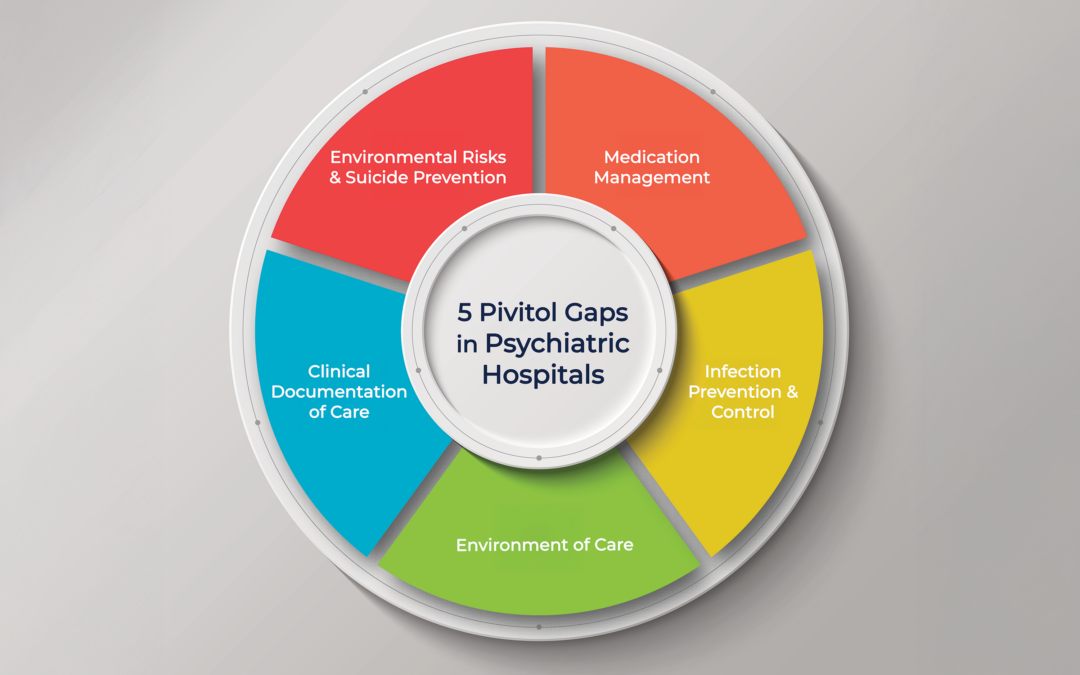
The Five Persistent Psychiatric Hospital Patient Safety Gaps
These gaps represent recurring patient safety challenges that highlight systemic issues demanding proactive improvement.
1. Environmental Risks & Suicide Prevention
Suicide remains one of the most common sentinel events in psychiatric care. Environmental risk assessments must identify and mitigate ligature risks and self-harm opportunities. Older facilities often face cost barriers and unclear guidance in addressing these risks.
Action Tip: Conduct quarterly ligature risk rounds with a multidisciplinary team (clinicians, facilities, frontline staff) to spot hazards and track mitigation efforts.
2. Medication Management
According to Department of Health & Human Services Medication errors—wrong dose, time, route, or patient—are among the most frequent adverse events. These issues often stem from poor communication, inadequate labeling, and clunky technology that encourages unsafe workarounds.
Action Tip: Implement barcode scanning at the bedside to ensure real-time verification of the “five rights” of medication administration.
3. Clinical Documentation of Care
Incomplete or inaccurate records—especially those related to risk assessments, treatment goals, or discharge planning—create safety and compliance vulnerabilities. Burnout, policy-to-practice gaps, and unintuitive EHRs are key drivers.
Action Tip: Use real-time documentation audits (spot checks by charge nurses or QI teams) to reinforce accuracy and catch gaps before they affect patient care.
4. Environment of Care
Seemingly minor issues, such as clutter, damaged furniture, or blocked fire exits, often reflect deeper cultural and leadership gaps. The state of the physical environment signals how seriously an organization prioritizes safety.
Action Tip: Launch a “15-minute safety sweep” at the start of each shift, empowering frontline staff to identify and fix hazards on the spot.
5. Infection Prevention and Control
Lapses in high-level disinfection and sterilization of medical equipment directly endanger patients and staff. Failures here often reveal gaps in staff training and inconsistent adherence to protocols.
Action Tip: Use visual management tools (color-coded bins, step-by-step posters, or checklists at the point of care) to make correct disinfection and sterilization processes the easiest choice.
Human Factors Engineering (HFE) in Psychiatric Hospitals
Human Factors Engineering (HFE) shifts the focus from blaming individuals to designing safer systems that account for how humans actually work. To minimize psychiatric hospital patient safety gaps, this means intentionally creating environments, tools, and workflows that prevent errors before they occur.
Practical Applications – Agency for Healthcare Research and Quality
1) Ligature-Resistant, Intuitive Environments
- Design patient rooms and common areas that minimize self-harm risks while still feeling therapeutic.
- Use furniture, fixtures, and hardware that are ligature-resistant and easy for staff to inspect and maintain.
- Incorporate intuitive layouts that make safety checks more natural, reducing the risk of missed observations.
2) User-Centric Electronic Health Records (EHRs)
- Streamline workflows by reducing unnecessary clicks and complex navigationInfection.
- Embed clinical decision support tools that are clear, timely, and avoid “alert fatigue.
- ”Align documentation templates with regulatory requirements (e.g., CMS, TJC, ACHC), so compliance is built in rather than an afterthought.
3) “Forcing Functions” to Prevent Errors
- Use medication-dispensing systems that require barcode scanning before administration, preventing wrong-patient or wrong-dose errors.
- Design processes where risky workarounds (like overriding medication warnings) are eliminated through safer alternatives.
4) Hardwired Accountability & Maintenance Systems
- Build safety checks (ligature rounds, fire safety, equipment checks) directly into workflows, with automated reminders and tracking.
- Use dashboards that flag overdue tasks or incomplete rounds, so accountability is visible at every level.
5) Mistake-Proofing Infection Control
- Apply Lean methods (e.g., color-coded supplies, standardized room setups) to make correct procedures the easiest choice.
- Use visual cues (like hand hygiene lights or sensors) to reduce missed steps.
- Track compliance with real-time data rather than relying solely on retrospective audits.
Takeaways
When systems are poorly designed, frontline staff often invent “workarounds” just to get the job done. These aren’t signs of laziness or incompetence—they are symptoms of a system that doesn’t fully support safe, compliant behavior. Unfortunately, such workarounds can create hidden risks.
Blaming individuals or telling staff to simply “try harder” does nothing but foster a blame culture—one where errors go unreported, fear grows, and the cycle of non-compliance continues.
Of course, the truth is that there’s no single simple solution. Instead, sustainable improvement comes when hospitals commit to systemic redesign—building processes that make the right actions the natural, easiest actions.
“Every system is perfectly designed to get the results it gets.” – W. Edwards Deming
Barrins & Associates
Need help navigating these challenges? The Barrins team of accreditation and regulatory experts can provide readiness assessments, policy, procedure, document, and process updates, as well as staff training tailored to the latest standards. Contact us today.
Barrins & Associates: “Your Path to Accreditation Success: Our Experts Know Every Step!”